
Human-in-the-Loop (HITL) Systems: The Future of AI
For a long time, AI was framed like a choice between two extremes: humans do everything, or machines do everything.
But the real shift happening in practice is collaborative intelligence. The system does the heavy lifting, and a person stays intentionally involved at the moments that matter.
That's what human in the loop design is aiming for. Not slower automation. Smarter automation.
In this guide, you'll learn what Human-in-the-Loop (HITL) actually means, how it differs from other oversight models, and why it becomes even more important once you start using agentic AI (systems that plan and execute multi-step actions).
You'll also see what this looks like when it's enforced in a real platform, including how Cognis AI supports centralized oversight, controlled knowledge grounding, and permissioned approvals so you can keep automation moving without losing control.
Sidenote: When AI sounds confident, it's easy to assume it's correct. HITL exists to keep that confidence from turning into irreversible mistakes.
What is Human-in-the-Loop (HITL)?
Human-in-the-Loop (HITL) is a strategic design approach that intentionally embeds human judgment, expertise, and moral discernment across the machine learning lifecycle. That includes training, evaluation, validation, and real-time deployment.
The key idea is simple: the automated system cannot proceed to its final action until a human has explicitly reviewed, approved, or modified the proposed output. So the AI isn't treated like an infallible component. It's treated like a capable partner.
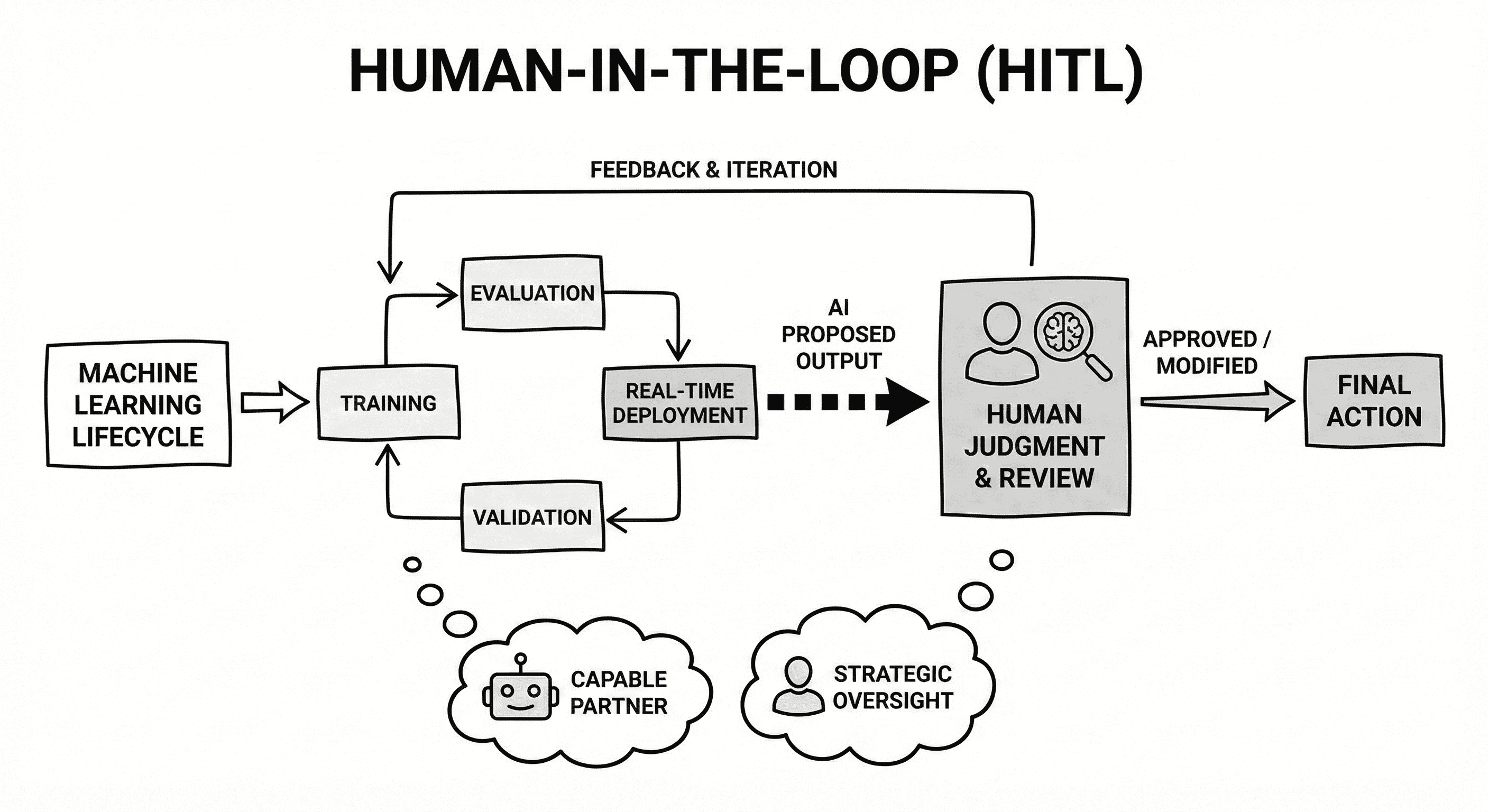
Human-in-the-Loop
Where does the human loop actually happen?
HITL gets operationalized at four critical junctures:
- Data annotation and curation to create ground truth.
- Model training and tuning using feedback methods like Reinforcement Learning from Human Feedback (RLHF), where people rank or score outputs to teach nuanced qualities (like tone or helpfulness).
- The message is automatically resent to the new model and Cognis creates a demarcation of the moment in the chat where you branched with numbered options for accessing each respective branch
- Inference oversight, where humans validate model outputs before they're acted on in production. A safety net against hallucinations.
- Edge-case and exception handling where out-of-distribution scenarios are escalated for human adjudication.
DID YOU KNOW?
HITL isn't just a button you click at the end. It's a governance and operating model for human-in-the-loop systems.
And it shows up everywhere, from human in the loop machine learning practices (labeling, feedback, evaluation) to how you design approvals and accountability for human in the loop artificial intelligence in production.
This is also why platforms like Cognis AI focus on making the loop enforceable (and reviewable), not just optional.
Why Human-in-the-Loop Matters in AI & ML
If you're building or deploying AI in high-stakes, ambiguous, or ethically sensitive environments, mostly right isn't good enough. HITL exists because humans bring contextual understanding, moral reasoning, and domain judgment that purely statistical systems don't have.
1) Better accuracy and reliability
Humans catch mislabels, anomalies, and edge cases that quietly degrade model performance. That matters in training. And it matters in production. In document processing, combining AI with human verification can reach accuracy rates up to 99.9% [1].
2) Bias mitigation and ethical alignment
Training data can encode historical bias. Human oversight is the lever for spotting and mitigating that bias before it becomes a harmful output
3) Transparency, explainability, and auditability
HITL reduces the black box risk by making decisions reviewable and attributable. That supports audit trails. It aligns with oversight expectations in frameworks like the EU AI Act (Article 14) and the NIST AI Risk Management Framework [2].
4) Trust and adoption
People adopt AI faster when they know a person is still responsible. That's the emotional logic behind humans in the loop ai. You keep the speed of automation. But you also keep accountability.
Practically, it's easier to do well when you run your work through structured human-in-the-loop workflows that capture approvals, overrides, and corrections as real operational data.
That’s where systems like Cognis AI tend to shine: if you centralize oversight, capture human decisions, and control what knowledge gets used, you make trust scalable, not fragile.
Human-in-the-Loop vs. Fully Automated Systems
Fully automated systems are fast and scalable.But speed is not the same thing as safety.In ambiguous situations, small mistakes can become big outcomes.
So the real question isn't automation or no automation? It's, where do you put human authority in the pipeline?
The control hierarchy matters
These models are primarily distinguished by two things:
- Control hierarchy: who has final authority.
- Proximity to execution: how close the human is to the final action.
Here's a map:
- Human-in-the-Loop (HITL): A human must review, approve, or modify before final action.
- Human-on-the-Loop (HOTL): The AI runs mostly independently; a human monitors and intervenes by exception.
- Human-in-Command (HIC): The human holds total authority; AI is decision support.
- AI-in-the-Loop (AITL): AI augments a mostly human process, accelerating routine work.
Why this difference matters in practice?
If you want the machine to move quickly but still stay accountable, you need clear handoffs. That's exactly what human-in-the-loop workflows provide. They let the AI do the repetitive and computational parts and they reserve human judgment for the points where errors, ethics, or ambiguity matter most.
This is also why teams often invest in a centralized workspace and permissioned approvals (features you see emphasized in platforms like Cognis AI): the loop isn't just about review, it's about who can approve what, and when.
Where do humans in the loop show up most?
Typically, at the moments closest to irreversible execution: approving a high-impact decision, validating a risky output, or adjudicating an exception.
That's also the core mindset behind human in the loop machine learning when you zoom out: the human doesn't just label data once, they steer learning and action over time.
Challenges of HITL Systems
HITL is powerful. But it's not free from caveats. If you design it casually, you can end up with a slow, expensive, inconsistent process. So let's name the trade-offs clearly.
1) Scalability and cost
Human labor is expensive. And it doesn't scale linearly with data volume. If you require human review for everything, humans become the bottleneck.
Humans introduce delay. That can be a problem for time-sensitive tasks like autonomous driving or high-frequency trading.
3) Human error and inconsistency
Humans get tired. They get distracted. And they bring subjective variance. That can create noisy labels and inconsistent standards unless you add quality controls.
4) Automation bias
There's a real risk that reviewers start rubber-stamping AI outputs. That defeats the purpose of oversight.
5) Privacy risks
If sensitive information is shown during review, you increase the security and compliance burden. This is where governance becomes practical, not theoretical. You need controlled access. You need careful data handling.
And you need a way to prove who saw what and who approved what, especially when you're deploying human in the loop artificial intelligence in regulated contexts.
The silver lining: all these challenges are manageable. But only if you design the loop intentionally (with clear roles, triggers, and guardrails), not as an afterthought.
Best Practices to Implement HITL in AI/ML Projects
- Start with ground truth. Build data annotation and curation into the plan. Use domain experts to label and structure raw data so the model learns from high-quality examples, not noisy assumptions.
- Use human feedback during training and tuning. Apply Reinforcement Learning from Human Feedback (RLHF), where humans rank or score outputs to teach subtle concepts (like tone, empathy, or helpfulness) that are hard to encode algorithmically.
- Design inference oversight as a real workflow. In production, humans need to act as active validators who review AI-generated predictions before they are acted upon as a direct safety net against hallucinations.
- Plan for edge cases. When data is out-of-distribution, escalate it for human adjudication. Humans apply common sense and adaptability, where purely statistical models often fail.
- Define strategic trigger points. Use confidence-based routing (for example, flagging outputs below a threshold such as 80%) and risk-based gates for actions with significant financial or legal impact.
- Make the handoff easy to execute. Provide the reviewer with the model's reasoning and the specific evidence that triggered escalation, so humans can decide quickly without unnecessary cognitive load.
- Capture every correction. Every human override, approval, or modification should become a new labeled signal for continuous evaluation and retraining. This creates a learning flywheel and helps address concept drift over time.
- Build quality controls for human reviewers. Reduce inconsistency with approaches like consensus scoring and inter-rater reliability checks, especially when labeling or validating at scale.
- Reduce fatigue on purpose. HITL fails when reviewers are exhausted. Systems that use a familiar interface (for example, a Rich UI that mirrors workplace apps, as Cognis AI does) can reduce cognitive load and improve review quality.
- Enforce governance with permissions. Use granular Identity Access Management (IAM) so only qualified humans can approve sensitive actions, and keep an auditable chain of responsibility.
How does Cognis Reinforce Humans in the Loop
If HITL is the philosophy, enforcement is the hard part. Cognis AI relates to this problem as a multi-LLM agentic automation platform that structures oversight into the way work actually runs. Not as an add-on. As part of the operating system.
Centralized workflow oversight
Cognis AI combines generative AI-led automation with a centralized workspace. That matters because fragmented tools create fragmented oversight. A central command-and-control view makes it easier to see what the AI is doing and where human approvals should happen.
Custom memory for data control and grounding
Cognis leverages custom memory as a central knowledge base. Humans control what data is included or excluded from chats. That helps ground outputs in human-verified information and reduces hallucinations.
It also uses its own processing and custom memory to bypass vulnerable push-and-pull data transfer mechanisms found in standard Model Context Protocols (MCP), strengthening enterprise-grade data governance.
Rich UI to reduce fatigue
Human review is only as good as human attention. Cognis uses a Rich UI that mirrors commonly used workplace apps inside the chat window. That familiarity is designed to reduce fatigue and increase productivity during review and approval.
Granular IAM so the right human approves the right thing
Not every decision should be reviewed by someone. It should be reviewed by a qualified person. Cognis offers granular Identity Access Management (IAM) that mirrors organizational hierarchies, so sensitive decisions land with the right approver.
In practice, that's what makes collaborative intelligence scalable: humans stay in control, but they don't have to micromanage every token.
Future of Human-in-the-Loop AI
As AI becomes more agentic, oversight stops being a nice-to-have. It becomes a design requirement. Agentic AI refers to autonomous, goal-directed systems capable of creating context-specific plans and executing multiple steps across various applications. And that autonomy raises the risk of drift and overreach.
Why the loop matters more for agents
Agents can call tools. They can query APIs. They can modify systems. So a single bad assumption can cascade into a series of bad actions.
That's why modern agentic frameworks rely on:
- Strategic trigger points where an agent must pause and ask permission before high-impact actions (like deleting data or approving financial transactions).
- Interrupt protocols where execution pauses mid-workflow until a human reviews context and approves or redirects.
- Human-as-a-tool patterns where the agent explicitly queries a human for context, fact-checking, or clarification.
If you've seen how langgraph human in the loop patterns work, this will feel familiar. Frameworks like LangGraph can pause execution via interrupt() so a human can approve or redirect the plan.
When you combine that with controlled knowledge grounding and permissioned roles (the kind of guardrails Cognis AI emphasizes), you get a future where agents can move fast without operating unchecked.
Collaborative intelligence becomes the default. Not because it's trendy. Because it's the safest way to scale real-world autonomy.
Frequently Asked Questions
HITL requires human approval before final action; HOTL is human monitoring by exception; HIC keeps the human in total authority while AI supports decisions; AITL uses AI to augment mostly human workflows.
At four critical junctures: data annotation/curation, training and tuning via human feedback (including RLHF), inference oversight in production, and edge-case/exception handling for out-of-distribution scenarios.
Use strategic trigger points: confidence thresholds and risk gates for actions with significant financial, legal, or operational impact.
Don't route everything to humans. Route high-risk, low-confidence, or out-of-distribution cases to humans, and let low-risk automation run with monitoring where appropriate.
Design the review so humans get the context and evidence they need, reduce fatigue, and keep clear accountability (so approvals aren't just rubber stamps).
In langgraph human in the loop setups, interrupt protocols (like interrupt()) can pause execution mid-run so a human can approve or redirect the agent's next step.
Custom memory helps control what information is included or excluded when grounding outputs; granular IAM ensures only qualified humans can access sensitive data and approve sensitive actions, and that decisions are reviewable and attributable (useful for audit trails and compliance).
No. It's about choosing the right control points, so automation scales without losing human judgment and responsibility.
External References
- What is human-in-the-loop? IBM. Read the article here.
- Human-in-the-Loop AI (HITL) - Complete Guide to Benefits, Best Practices & Trends for 2026. Parseur. Read the article here.
- Marry Jeffy (2025). Human-in-the-Loop vs. Full Autonomy: Striking the Balance in AI-Driven RPA. Read the article here.
- Kaufmann et al. (2025). A Survey of Reinforcement Learning from Human Feedback. Read the article here.
- AI in the Loop vs Human in the Loop: A Technical Analysis of Hybrid Intelligence Systems. IBM Community. Read the article here.
Generative AI
AI Ethics
AI Innovation
Machine Learning
Contact Us
Fill up the form and our team will get back to you within 24 hrs